
TECHNOLOGY & VALIDATION
Evidence before application
NanoSense develops patented nano-optical sensing technology designed to detect selected molecular compounds in real time — in compact systems engineered for use outside the laboratory.
THE TEST
Independently verified real-time TBP detection.
The test was designed to evaluate whether the NanoSense sensing platform could detect TBP in real time under controlled conditions. A baseline reading was first established, after which the sensor was exposed to a known concentration of TBP. The resulting sensor output was recorded continuously throughout the exposure period and compared against an independent laboratory method to confirm accuracy.
What was tested:
Detection of TBP (tributyl phosphate) using the NanoSense portable sensing platform.
Setup:
Sensor unit positioned in a controlled test environment, with a fixed exposure chamber and consistent airflow conditions to ensure repeatable results.
Objective:
To demonstrate that the sensor can detect TBP exposure in real time, with the result independently verified against a recognised analytical method.
CONTROL
A different approach to molecular detection.
Before TBP was introduced, the sensor was allowed to run under normal conditions to establish a baseline reading. This control period shows what the sensor output looks like with no target compound present, and gives a stable reference point against which the exposure response can later be measured.
Baseline reading:
With no TBP present, the sensor output remained flat and stable, showing only minor natural variation consistent with normal background conditions.
Why it matters:
The control period is what makes the exposure response meaningful — without a stable baseline, a rise in the signal during exposure couldn't be reliably distinguished from normal fluctuation.
TBP EXPOSURE
How Exposure was introduced.
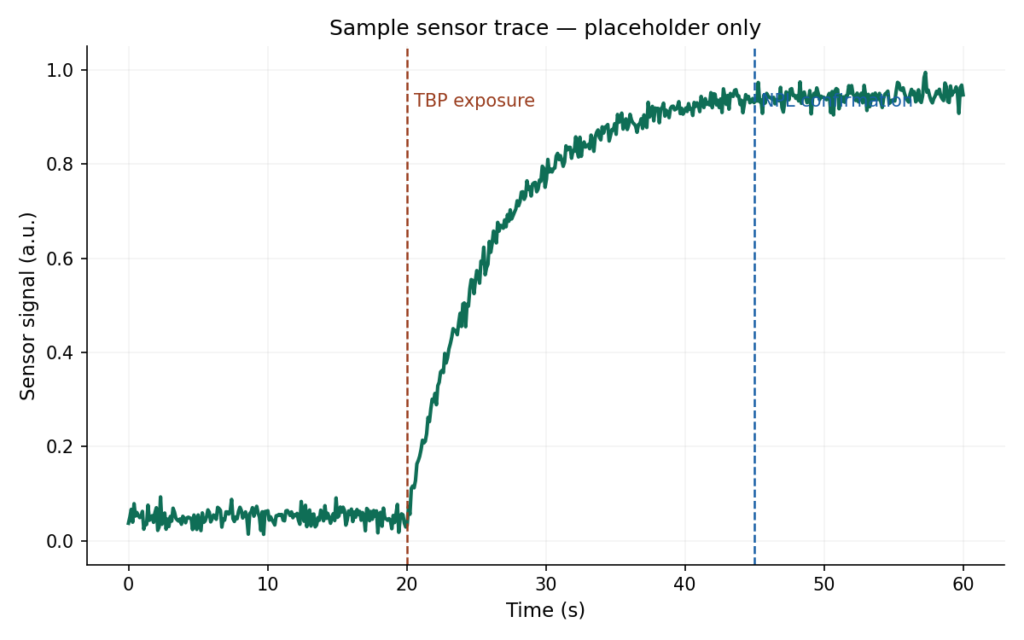
TBP was introduced to the sensor's detection chamber immediately following the baseline recording period, using a controlled delivery method to ensure a consistent and repeatable concentration. The exposure point is clearly marked on the sensor trace, allowing the transition from baseline to response to be observed directly.
Timing:
TBP exposure began immediately after the baseline period concluded, allowing a clear before-and-after comparison on the same continuous trace.
Exposure method:
TBP was introduced to the sensor's detection chamber under a fixed, controlled concentration to ensure a consistent and repeatable test condition.
Real Time Sensor Response
Response curve:
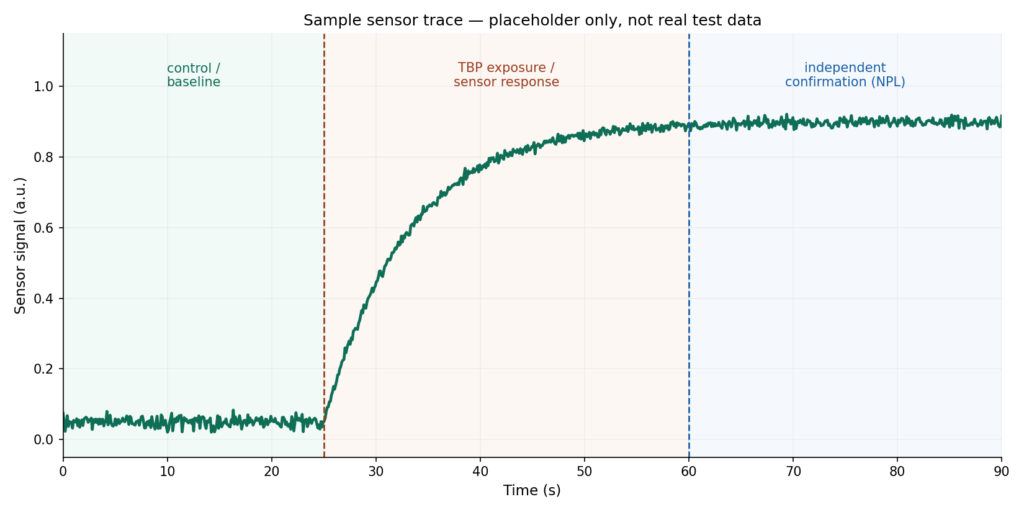
The trace shows a clear upward shift from baseline once exposure began, rising steadily before levelling off into a stable elevated signal.
Timing:
The sensor began responding within moments of TBP being introduced, with the signal change clearly visible on the same continuous trace as the exposure point.
Signal change:
The response represents a marked, sustained change from baseline — distinct enough to be clearly identified against the earlier control period.
Independent NPL GC/MC Confirmation
Method used:
GC/MS analysis was carried out independently to verify the presence of TBP in the test sample, providing a laboratory-based cross-check against the sensor's real-time output.
Outcome:
The independent analysis confirmed the sensor's detection, supporting the real-time response observed during testing.
INTERPRETATION
Plain-language summary.
Real-world Capability.
Watch the test
Where could you take NanoSense?
We’re looking for organisations with the expertise, environments and ambition to help turn NanoSense technology into mission-specific sensing solutions.